
Ontario Appellate Bar Series - Appearance Leaderboards
This is one article in a series which reviews the composition of counsel who appear before the Ontario Court of Appeal.
In addition to reviewing the composition of counsel for all appearances before the Ontario Court of Appeal in 2024, in light of the fact that members of the appellate bar often specialize in addressing appeal matters to a certain extent, a leaderboard was created for lawyers who appeared as counsel of record more than six times to determine if there was a disparity in gender among those who appeared before the court most frequently.
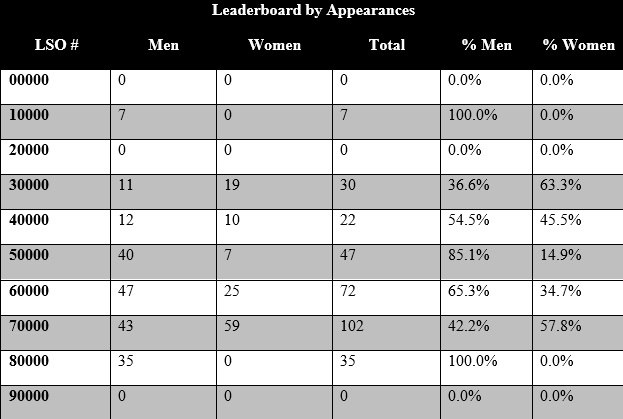
This leaderboard includes 31 lawyers who appeared seven times or more over the course of 2024, with a total of 315 appearances. There were two lawyers who appeared more than 20 times: one man (with 26 appearances) and one woman (with 23 appearances). Of the 31 lawyers, approximately 65% (20) are men and approximately 35% (11) are women, with the men accounting for approximately 62% (195) of appearances, and the women accounting for approximately 35% (120) of appearances.
When the information is sorted by frequency of appearance, in all seniority bands except 30000 (in which there is one man and one woman), and the 70000s (which represents lawyers called to the bar in June of 2016 or later), men accounted for the majority of appearances across all levels of seniority on the leaderboard:
When sorted by unique lawyer rather than by appearance totals, however, the numbers reflect relative balance at the more senior levels, with lower gender balance in mid-career advocates in the 50000 and 60000 band, and a lack of gender balance among more junior lawyers in the 80000 band:
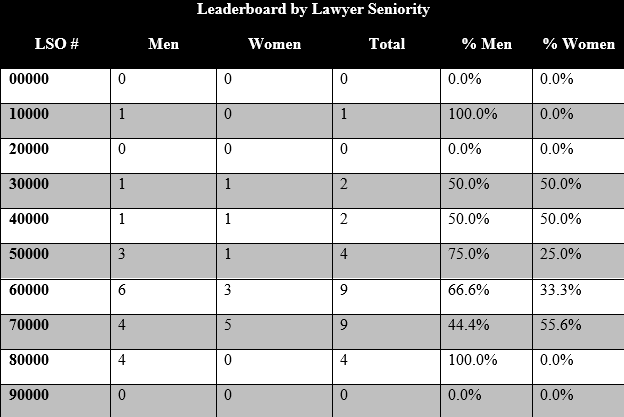
In the leaderboard counts, while there is some gender parity among senior counsel who appear most frequently before the Court of Appeal, there is still a gender imbalance in both appearances and for counsel of record across several seniority levels.
Interested in this article series? Future articles will include an analysis of appearance data as compared to lawyer population data.
A note on this article and analysis:
The figures included above are for information purposes only (and are obviously not legal advice). The information collected was drawn from publicly available decisions released by the Ontario Court of Appeal as published on CanLII for 2024, and is subject to certain limitations which are inherent in relying on only publicly available information as to seniority and gender. The gender information for counsel is not publicly available from the Law Society of Ontario. In order to ascertain the gender of counsel, after counsel’s name was searched in the LSO Lawyer and Paralegal Directory (or provincial equivalent), a general online search was performed for the lawyer to locate their law firm biography, academic publications, news articles or online commentary, LinkedIn profile, and/or any other social media or online presence which indicates the pronouns used by the lawyer. Lawyers using he/him pronouns are identified in the analysis as men, while lawyers using she/her pronouns are identified in the analysis as women. No lawyers using they/them pronouns were identified as part of the analysis, and therefore a category for non-binary individuals has not been included. There were several cases which included counsel of record with a more common name. For these lawyers, there were several potential matches in the LSO Lawyer and Paralegal Directory. As such, it was not possible to determine with any degree of accuracy which lawyer listed in the LSO Lawyer and Paralegal Directory was the lawyer who appeared as counsel of record. In the matters in which this was the case, an assumption was made as to the gender of counsel based on counsel’s name. Lawyers who are not licensed with the LSO are excluded from the LSO number information as they do not have a LSO number.
Given its dominant position in Canadian appellate advocacy relative to the other provincial courts of appeal, the matters heard by the Ontario Court of Appeal and who appears as counsel is information which certainly calls for at least some measure of analysis. Admittedly, a more robust review would include the ethnic, cultural, and gender diversity of both the litigants and their counsel of record. However, information about cultural or ethnic backgrounds, for example, is of a more personal nature and not publicly available. Conducting such an analysis would necessarily require more invasive research methods, such as interviews, focus groups, and/or surveys. This project is limited by both time and structural constraints, with its primary goal to serve as a methodological and intellectual interest-driver, potentially encouraging others to consider the appearances by counsel before the Ontario Court of Appeal and other appellate courts across Canada. A further study of this information, as well as the ethnic and gender diversity of counsel who appear before the courts, would provide the basis for a comprehensive longitudinal study.